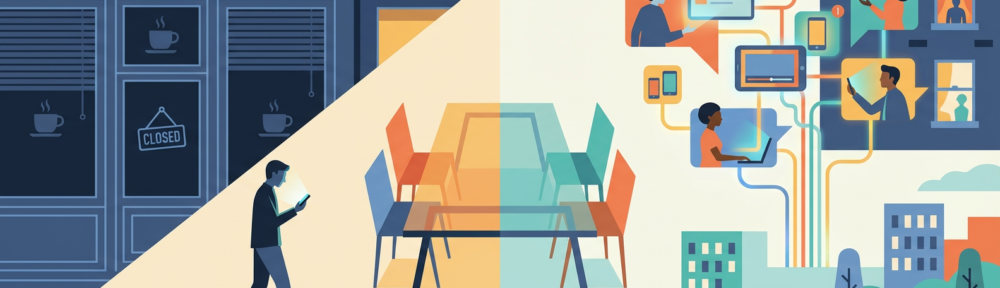
The Numbers Don’t Lie, But They Don’t Tell the Whole Story
There’s a spreadsheet somewhere that proves my nostalgia isn’t just sentiment. In 2025, independent cafés across America closed at a rate we haven’t seen in a decade. Over 4,200 shops shut their doors between January and October alone, according to the National Coffee Association’s annual survey. That’s an 18% year-over-year increase. Eighteen percent. Not a rounding error. Not a market correction. An exodus.
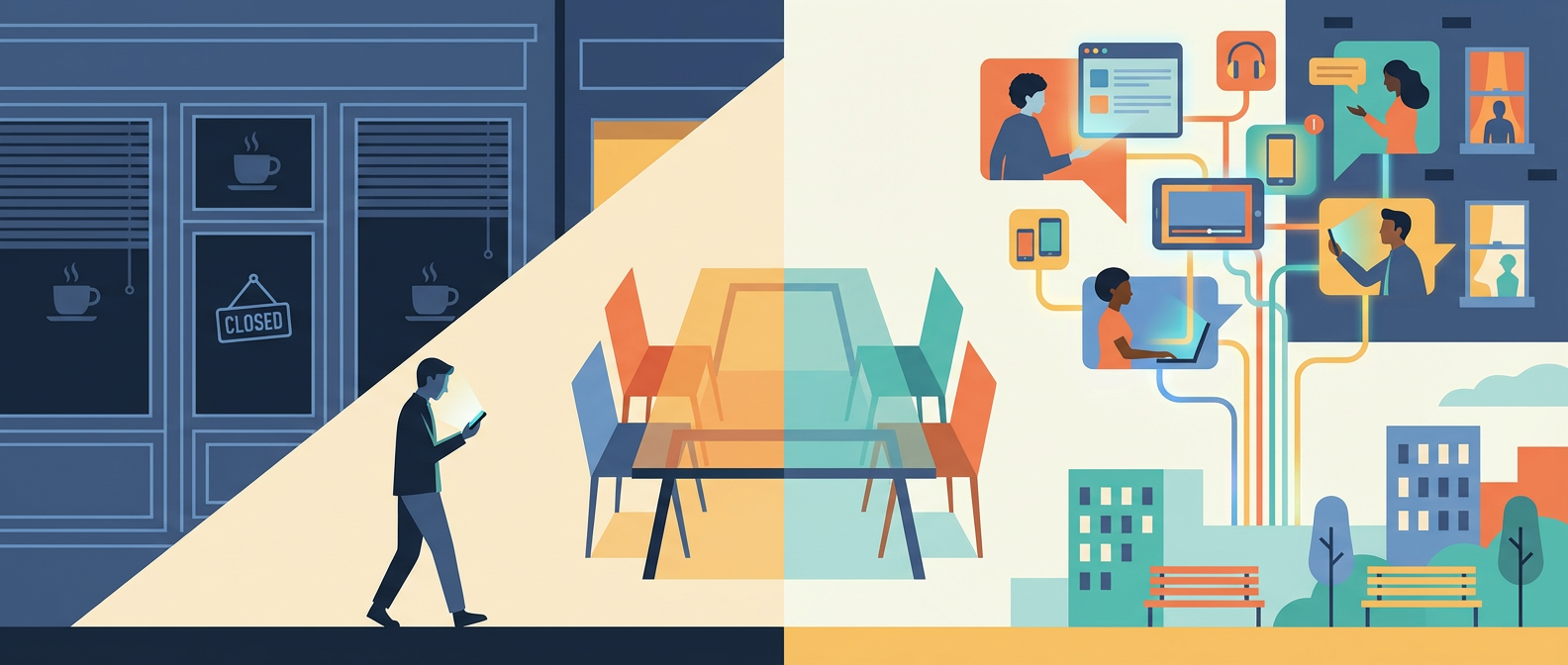
But here’s the uncomfortable part: those numbers are just symptoms. The disease is something quieter and more sinister. It’s the slow erasure of spaces where nothing is required of you except your presence. Spaces where you could sit for three hours with one cappuccino and nobody would ask you to leave. Where conversations started between strangers over a shared outlet. Where the barista knew your name because you’d been coming in on Thursday mornings for two years, not because you’re an influencer.
We’re not just losing cafés. We’re losing the infrastructure of community itself.

The Concept We Took for Granted Until We Lost It
Ray Oldenburg wasn’t writing about coffee culture when he coined the term “third place” back in 1989. He was writing about something deeper: the public sphere that exists between home (first place) and work (second place). The in-between where spontaneity happens. Where culture actually forms, often in spite of intention.
For decades, the café was the perfect third place. It had economics that worked. Rent was manageable. Labor was flexible. A passionate person with a couple thousand dollars and a decent coffee source could create a gathering spot. That arithmetic has evaporated.
Researchers at MIT Media Lab’s 2025 third place decline study found something that should alarm anyone who cares about how we actually live: third-place density in major US metropolitan areas has fallen 22% since 2020. That’s not just about cafés. It’s about the entire ecosystem of informal gathering spaces contracting simultaneously. Bars. Bookstores. Community centers. Galleries. The supporting cast of urban life, all vanishing in parallel.
The Economics of Displacement
Let’s talk about what actually killed the independent café, because it matters which villain gets top billing. Commercial real estate in urban centers hasn’t just increased. It’s undergone a kind of financialization that older small business owners never had to contemplate. When Monmouth Coffee, an institution in London’s Borough Market for decades, closed two of its three locations in early 2025, the reason was brutally simple: rent had increased 40% since 2022. Forty percent in three years. There’s no coffee markup that survives that math.
The landlords aren’t evil. That’s what makes this harder to articulate. They’re responding to capital flows. Borough Market is prime real estate. Of course they want market rate. Of course they’re leasing to chains and corporate tenants who can absorb those costs through operational leverage. The market is working exactly as designed. And that design has no room for a café that primarily exists as a gathering space. That’s not a business model anymore. That’s a charity masquerading as commerce.
What’s replaced café culture in some cities is almost darkly funny: the anti-café movement, where you pay by the hour to sit in a space, not by consumption. No obligation to buy anything. Just rent the air. That model saw 60% growth in new US city openings in 2025 according to IBISWorld. We’re literally trying to turn community into a utility now. Pay your hourly fee. Bring your laptop. Perform solitude alongside other solitary people. It’s efficient. It’s also completely pathological as a solution to the problem we’re trying to solve.
The Loneliness Epidemic Is Not Accidental
There’s a direct line between third-place collapse and the mental health data that should terrify urban planners. The Pew Research Center 2025 loneliness report found that 47% of adults under 35 now report experiencing chronic loneliness. That number was 30% in 2019. Seventeen percentage points in six years. The fastest-growing cohort. The demographic that should theoretically have the most social infrastructure and digital connection tools available.
We can pretend that’s about Instagram and dating apps and TikTok decimating real connection. But that’s reductive. Those platforms filled a vacuum that had already opened. We were already isolated before we built tools to manage isolation efficiently. The café was one of the few remaining spaces where weak ties could form. Where you could exist in public without performance. Where boredom could lead somewhere unexpected instead of being immediately resolved by algorithmic content.
Now we’re paying hourly to sit alone in repurposed storefronts. Meanwhile, the data suggests we’re lonelier than we’ve ever been. These aren’t disconnected facts.
What Comes After the Third Place?
Here’s where I’m supposed to offer solutions, or at least hope. I’m genuinely uncertain whether I have either. The economic forces that killed the independent café are real and powerful. Zoning laws that might protect commercial space for small operators seem quaint now. The landlords have leverage. The chains have capital. The third place, as Oldenburg conceived it, might just be too economically inefficient for 2025 capitalism to tolerate.
But there’s something worth noticing in how we’ve responded to the loss: we’re recreating it artificially. Anti-cafés. Coworking spaces. Intentional community housing. We’re trying to engineer gathering through design when what made the café work was that it emerged organically from necessity and economics that no longer exist. We’re building museum exhibits of spontaneity and calling it culture.
The question isn’t whether we can recreate the third place. Maybe we can, with enough design thinking and venture capital. The real question is whether whatever we build will actually feel like the thing we lost. Whether it will have that crucial element of randomness and non-optimization that made the original meaningful. Whether it will ever be uncool enough, uncommercial enough, to actually function as a space for real community formation.
What’s your relationship to the third place? Have you noticed its absence in your own city? I’m genuinely curious how people are adapting, or if we’re all just getting used to being alone together.