The Death of Accidental Discovery
Spotify’s Discover Weekly thinks it knows you better than you know yourself. Last Tuesday, it confidently served me a playlist of “underground” tracks that included a song with 2.3 million streams and another that soundtracked a viral TikTok three months ago. The algorithm had confused popularity with authenticity, mistaking reach for relevance. This is the fundamental problem with letting machines curate culture.
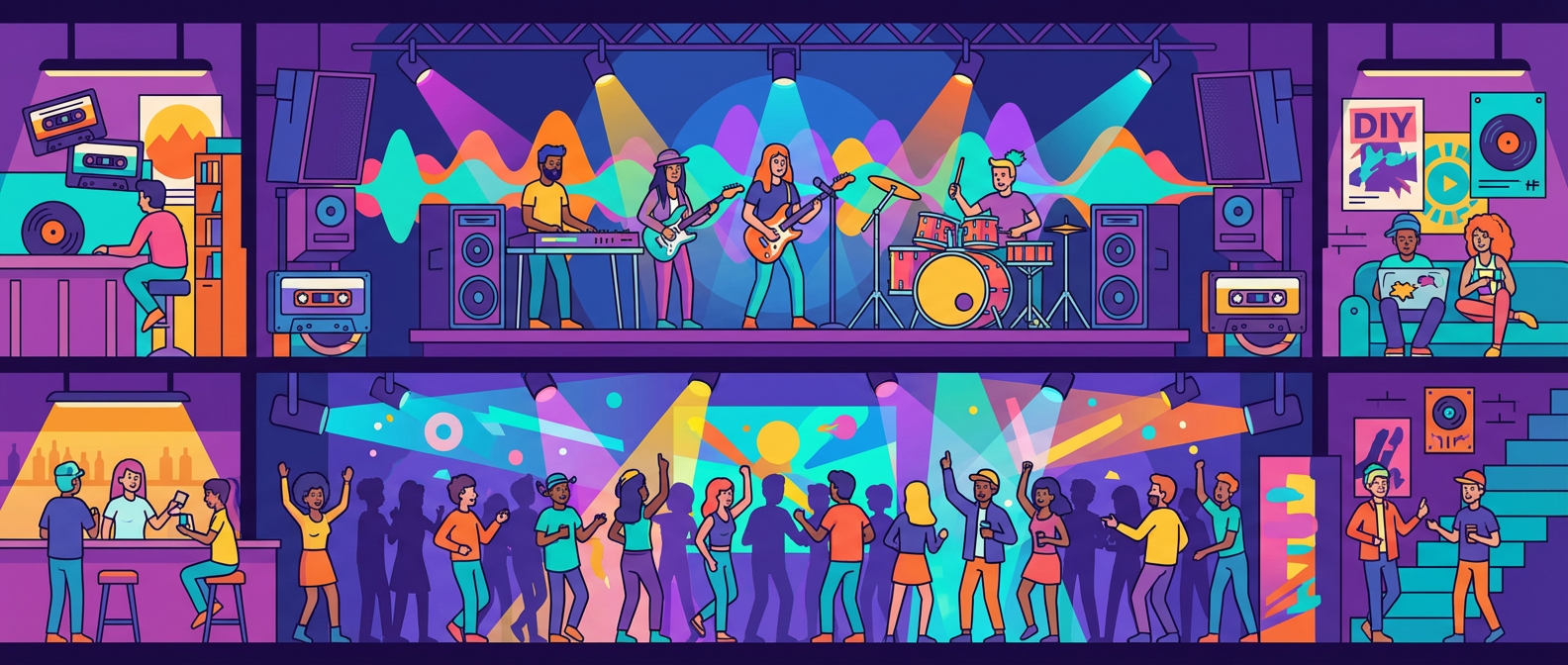
Real discovery doesn’t happen through recommendation engines optimized for engagement metrics. It happens when you follow that weird kid from your sociology class down a flight of sketchy stairs into a basement where someone’s set up a PA system between the water heater and a pile of laundry. It happens when you stumble across a Bandcamp page at 3am because you clicked through seventeen different artist collaborations like you’re following a Wikipedia rabbit hole.
The best music scenes have always existed in the margins, in spaces too small and too strange for algorithms to detect. They thrive on word-of-mouth networks, on the kind of social discovery that can’t be monetized or scaled. When platforms try to systematize this process, they inevitably kill what made it special in the first place.
Mapping the Unmappable
Every city has its invisible music infrastructure. In Philadelphia, it’s the network of house venues that spring up and disappear like pop-up restaurants, operating in the gray areas of zoning laws and noise ordinances. Someone converts their living room into a DIY space for six months until the neighbors complain or the lease runs out, then the scene migrates somewhere else entirely.
These spaces don’t show up on venue listing websites. You find them through friends, through band Instagram stories, through cryptic posts in Facebook groups with names like “Philly Weird Stuff” or “DC Basement Shows.” The barrier to entry isn’t financial, most shows cost five to ten dollars. It’s social. You need to know someone who knows someone.
This friction isn’t a bug. It’s the whole point. It creates communities of people who are genuinely invested in the music rather than just looking for something to do on a Saturday night. When you have to work a little bit to find something, you’re more likely to pay attention when you get there.
The geography of these scenes follows patterns that real estate developers would recognize. Artists get priced out of neighborhoods, so scenes migrate to areas with cheaper rent and more tolerant landlords. What was once happening in warehouses in Bushwick is now happening in garages in Ridgewood. The music follows the money, or more accurately, it follows the absence of money.
The Economics of Staying Underground
Here’s the cruel math of independent music: the moment something becomes financially viable, it stops being underground. Success in the traditional sense requires a level of professionalization that fundamentally changes the art being made. Label deals, festival bookings, press coverage—they all come with strings attached.
I watched this happen to a band from Baltimore called Soft Torture. They started making these gorgeous, experimental noise-pop songs in their drummer’s attic studio. Their early releases felt like secrets you wanted to share with only your most trusted friends. Then they got picked up by a mid-tier indie label, started touring regularly, and began writing more accessible songs to pay for gas money and van repairs.
The music wasn’t worse, exactly. It was just different. More polished, more predictable, more designed for the kind of venues that have proper sound systems and alcohol licenses. They had to make compromises to survive as working musicians, and each compromise moved them a little further from the underground ecosystem that originally nurtured them.
This isn’t a moral judgment because artists deserve to make money from their work. But it illustrates the fundamental tension between underground culture and the economic systems that surround it. The most interesting art often happens in spite of capitalism, not because of it.
Digital Tools, Analog Communities
The internet hasn’t killed underground music scenes, but it has changed how they operate. Bandcamp remains the closest thing we have to a perfect platform for independent music because it takes a reasonable cut, pays artists quickly, and doesn’t try to impose algorithmic discovery on top of human curation.
Instagram has become the primary communication tool for DIY venues, but in ways that the platform’s designers probably never intended. Stories become event listings. Close Friends lists become guest lists. DMs become the new way to ask for someone’s address after 10pm when you can’t remember which house is hosting tonight’s show.
The most successful underground artists understand how to use these tools without being used by them. They treat social media as utility rather than performance space. They use streaming platforms for accessibility while maintaining direct relationships with their audience through email lists and physical releases.
What they don’t do is chase metrics. They don’t optimize for playlist placement or try to game the algorithm. They understand that building a sustainable underground music career means growing a small group of people who will follow you from platform to platform, from venue to venue, through whatever weird musical territory you decide to explore next.
The Persistence of the Physical
Despite everything being digital, the underground music economy still runs on physical objects. Cassette tapes have become the vinyl of DIY culture because they’re cheap to produce, easy to transport, and have their own aesthetic charm. Limited runs of 100 copies sell out in hours, creating a sense of scarcity that streaming can’t replicate.
Merchandise tables at basement shows function as micro-retail experiences. You’re not just buying a t-shirt; you’re making a small investment in an artist’s ability to keep making music. The transaction feels personal because it often is. You’re literally handing cash to the person who wrote the songs you just heard.
This physicality extends to the spaces themselves. There’s something irreplaceable about experiencing music in rooms that weren’t designed for it. The way sound bounces off concrete walls in a warehouse. The intimacy of watching someone perform three feet away from you in someone’s kitchen. The shared risk of being in a space that might not technically be legal. These elements can’t be digitized.
The underground persists because it offers something that algorithm-driven culture can’t: the possibility of genuine surprise. In a world where every experience is increasingly predictable and optimized, there’s radical value in not knowing what you’re going to get. If you want to find it, start paying attention to the margins. Look for the spaces that don’t advertise, the artists who don’t optimize, the communities that exist outside the reach of corporate curation. The best discoveries are still waiting in basements.