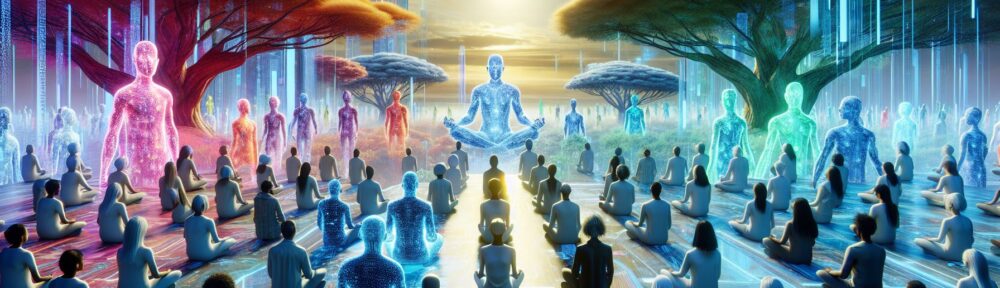
Hey there, fellow digital explorers! Today, I’m taking you on a tour of the unfolding universe of possibilities we currently label as the “Metaverse.” If you’ve ever wondered if we’re inching toward a world resembling the landscapes of “Ready Player One,” you’re not alone; I spend far too much time contemplating the implications and sheer coolness factor of an interconnected virtual reality world. Buckle up!
What is the Metaverse and Why Should We Care?
Let’s start with the concept, which sometimes feels slippery because of how much it can actually include. In simplest terms, the Metaverse is a collective, virtual shared space that’s emerging from the convergence of enhanced physical realities and persistent virtual realities. Still scratching your head? Think about it like this: it’s the Internet, evolved into immersive 3D experiences and persistent digital realms where you can interact with avatars, objects, and environments just as you might in real life.
And why does this virtual reality matter? Unlike traditional cyberspace, the Metaverse has the potential to be as broad and diverse as reality itself. Imagine a state where the lines between the offline and online worlds blur, creating new opportunities for innovation, work, entertainment, and even personal growth.
A New Canvas for Creativity
Welcome to the Metaverse where the only limitation is your imagination. No exaggeration! With tools we have now, like those from Unity (have to love these folks, right?) and Unreal Engine, designers can build fantastical worlds without earthly constraints. Maybe right now, you’re too busy with everyday games, but soon you might be living fully realized alternate lives in spaces with impossible architecture. And let’s not underestimate this: becoming a VR pioneer is actually possible. Like, literally!
Artists and creators are already using virtual reality mechanics for projects in everything from indie games to immersive theatre, architecture, and interactive storytelling. For us, consumers, the immediate benefits mean more immersive video games. Down the line? Possibly a complete reimagining of cinema. Remember those boring school lectures? Picture immersive reenactments via VR headsets today and even more advanced neural connections in the future.
Bridging Distances in Social Spaces
I bet I’m not the only one craving better virtual interactions. Ever felt lonely despite endless text messages and emoji exchanges? Well, you can put that smartphone down because the Metaverse promises something more sophisticated on the horizon. Real connections that go beyond social media posts and surface-level digital interactions.
Think about platforms like Horizon Workrooms and similar spaces where genuine feelings can transform into meaningful digital bonds, creating deeper connections than what we get from current social media. The potential is there for friendships that transcend physical distance and workplace collaboration that feels truly present, even when we’re scattered across the globe.
Shake Up the Workplace
Let’s shift gears and look at how this might change work entirely. Remote collaboration has already proven its worth, but the Metaverse could take it to the next level. Instead of staring at tiny squares on a video call, imagine walking into a virtual office space, pointing at 3D models during presentations, or brainstorming on digital whiteboards that feel as real as the physical thing.
Of course, there are challenges. Not everyone has access to VR equipment, and some people simply prefer face-to-face interaction. But for creative work, training simulations, and global collaboration, the possibilities are genuinely exciting. We might see new job categories emerge while others transform completely. The question isn’t whether this will change how we work, but how quickly we can adapt to make it work for everyone.